
Digital advertising cookies are back in the news with Google’s move in January 2024 to opt out 1% of Chrome users from default acceptance of third-party (3P) cookies. Google’s current announced plan is to deprecate all 3P cookies from Chrome by late 2024. This news follows several delays by Google on the timeline for 3P cookie deprecation, which was first announced in 2020.
Why this matters
3P cookies still play an important role in digital advertising on the open internet. In particular, they assist with the identification of targeted audiences, retargeting users based on website activity, and attributing conversion activities to advertising.
However, the utility of 3P cookies has diminished dramatically over the past five years as Apple (iOS, Safari) and Firefox have blocked them by default in their products.
The long decline of 3P cookies
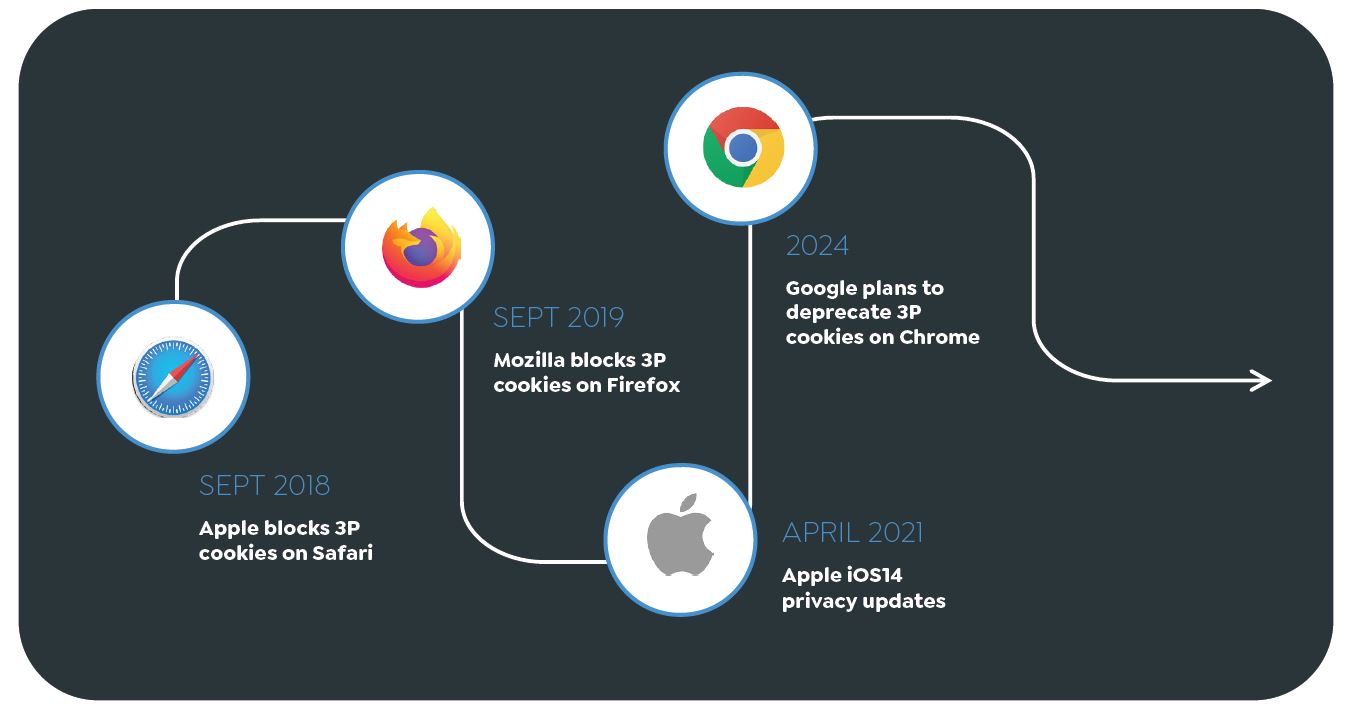
3P cookies are used in some digital ad channels but not at all in others, so the effect of Google’s actions will depend on the ad channels employed. For instance, Connected TV and digital audio use device IDs rather than 3P cookies. Currently, display and online video ads primarily utilize 3P cookies for audience targeting and attribution.
What are cookies?
A third-party (3P) tracking cookie is a small text file placed on your computer or mobile device by a website you visit. 3P cookies are used to track online activity across different websites, including purchases and other activities. This information can then be used to show targeted advertising and track actions taken after the exposure to advertising (registrations and sign-ups, purchases, etc.). Whenever someone uses the internet, especially on browsers like Chrome, their actions are tracked through 3P cookies.
3P cookies should not be confused with first-party (1P) cookies, which are used by websites to save and store login information and passwords, and are automatically accepted by the user’s browser. They are unaffected by Google’s recent 3P cookie deprecation.
What this means for digital advertising
The digital advertising industry will feel this shift most in two key areas—audience targeting and conversion attribution. The way we find the right user at the right time is changing, and the way we attribute conversions and other metrics is changing. As mentioned, not all digital media channels are impacted, just those that rely on 3P cookies the most (display and online video).
What comes next
There is good news in this transition. Given the shortcomings of 3P cookies, both for advertising and user privacy, the practices and technologies that replace 3P cookies will be an improvement. The transition might present challenges, but the outlook is positive for all parties.
Audience identification and targeting
For audience identification and targeting, there are three primary tactics to operate
successfully in a post-3P cookie digital ad world: contextual ad buying, first-party data, and identity technologies such as non-cookie durable IDs.
- Contextual advertising – Buying ads in the kind of content that attracts the desired
audience. For example, lifestyle and fashion content to reach young women, or business news to reach business decision makers. - First-party data – Using an advertiser’s CRM data, loaded into the advertising platform, to reach an advertiser’s customers and prospects that are similar to current customers (known as look-alikes).
- Identity technology solutions and non-cookie durable IDs – There are many potential technology solutions that can help replace cookies in defining and targeting audiences. Some group together internet users based on similar behaviors or interests (such as Google’s Topics). Others create durable IDs that can be used very much like cookies but are more persistent (good for advertisers) while allowing users to control how advertisers use those IDs (good for internet users). We’ll address below the alternative ID program with the most traction and scale so far, Unified ID 2.0.
GreenRubino is already using contextual advertising to reach our clients’ target audiences as well as to provide a relevant environment for ads. We are also using first-party data for many ad campaigns. Both tactics are becoming more important.
Google is driving this latest shift away from 3P cookies and has proposed (and abandoned) several solutions. Currently, their leading proposed solution for advertisers is Topics, which categorizes users of the Chrome browser into interest groups based on recent internet website browsing. For example, if a user is reading about “petcare,” they would be grouped into a cohort interested in pet-related topics. Advertisers could then target relevant groups.
Unified ID 2.0: an open solution
To provide good measurement and attribution of conversions on the open internet, a
consistent ID is required. The Unified ID 2.0 initiative, first proposed and launched by The Trade Desk, includes hundreds of partners and collaborators. Among them are major organizations in online technology, data, and content.
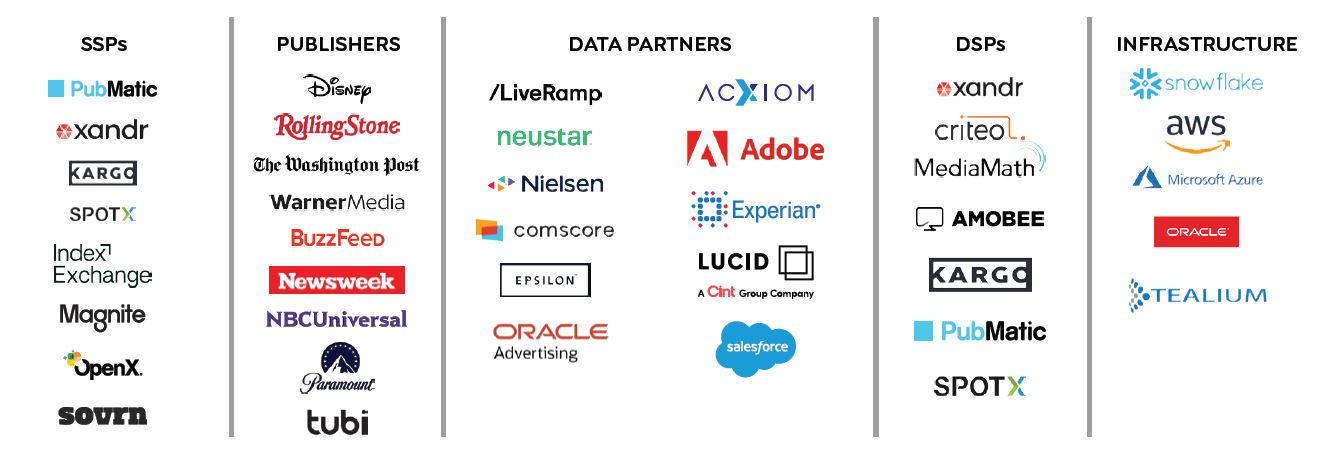
UID2 is an open-source ID framework. Built from hashed and encrypted email addresses, UID2 is designed to remain open and ubiquitous, and introduce upgrades to consumer privacy and transparency. Consumer transparency and control are built in to UID2.
Consumers will be able to view and manage their preferences and opt out at any time. To expand the number of UID2 user participants, publishers are ensuring that the fundamental value exchange of the internet—relevant advertising in exchange for free content—is clear to consumers.
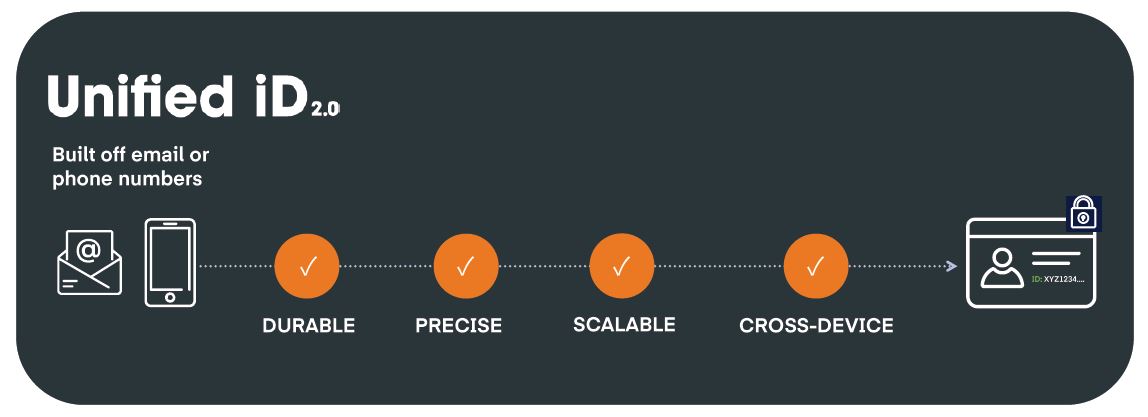
Currently, there are 300 million people associated with UID2 and that number is growing. As more cookies are deprecated, internet publishers will increase their efforts to enlist their site visitors in the program. As participation increases, the scale and productivity of campaigns using UID2 will also increase.
GreenRubino is already using third-party datasets with UID2s appended. Those efforts will continue and, as scale increases, allow us to identify the contribution of UID2 to digital ad campaigns.
Search Engine Marketing
SEM does not rely upon third-party cookies and is therefore unaffected by these changes.
Social Media
Meta has continued to evolve their 1P cookie option for audience targeting and attribution to help mitigate the impact of deprecated 3P cookies. In addition, since 2019, Meta has shifted advertisers toward the conversion API, which does not rely on 3P cookies.
Next steps
Working together with our clients, GreenRubino will continue the shift away from 3P cookies. We are actively developing a roadmap for each client to address changes to digital advertising, which will include:
- Opportunities to utilize advertiser first-party data
- Proposed testing and analysis of campaigns to understand the scale and performance measurement of 3P cookieless environments (Firefox and Safari)
- Analysis and insights into the scale and performance of UID2 and other relevant
alternative ID systems - Identification of key KPIs that can be employed in a 3P cookieless future
Summary
As of today, very little has changed from a year ago with regard to digital advertising campaigns. That’s especially true for CTV and digital audio campaigns. However, we expect to see an acceleration in the adoption, expansion, and scale of non-3P cookie solutions this year, especially if Google proceeds with their most recently announced deprecation timetable.
GreenRubino is preparing for the end of today’s 3P tracking cookie environment by utilizing available tools and technologies. As those tools are refined, we will provide clients with more data on their customers and prospects as well as improved ad performance. 2024 will be a period of transition, but we should soon see better results for advertisers and a better experience for internet users.